Setting up as a registered number plate supplier: kit, stock and paperwork
Plenty of businesses add number plates to what they already do. Garages, dealerships, motor factors, accessory shops and key cutters all sell plates alongside their main trade. Before any of them can sell a single plate, they must register with the DVLA.
Registering is the easy part. Running a plate business that stays compliant, keeps customers happy and makes money needs a little more planning. This guide covers how to register, what it costs, and what you need in place before your first sale.
Who needs to register
Any business that makes or sells number plates must be registered with the DVLA's Register of Number Plate Suppliers (RNPS). That applies whether plates are your main business or a small sideline.
- Every site needs its own registration. A business with three branches that each sell plates registers three places of business.
- Subsidiary companies register separately from the parent company.
- The rules apply online too. Selling plates through a website does not remove the need to register.
Selling or making plates without registering is an offence. It can lead to a fine of up to £5,000.
How to register
- Apply to the DVLA. You can apply online, or by post using form V940. If you have more than one site, you also complete form V940/1 for the extra locations.
- Pay the fee. There is a one-off fee of £40 for each place of business.
- Wait for confirmation. Registration typically takes around two weeks. Do not sell plates until it is confirmed.
- Receive your registration details. Keep your registration number safe. Trade suppliers will ask for it before they sell plates to you.
Postal applications go to The Register of Number Plate Suppliers, DVLA, Swansea, SA99 1DB. The RNPS team can be contacted at rnps@dvla.gov.uk or on 0300 123 0797.
Decide how you will supply plates
Before you buy anything, decide whether you will make plates yourself, buy them ready made, or do both.
- Making your own gives you same-day plates and a lower cost per plate at higher volumes. It needs equipment, space and trained staff.
- Buying ready made needs no equipment and removes production mistakes. You wait for delivery and pay more per plate.
- Doing both is common. Standard plates are made in-house, while shaped, oversize and specialist plates are bought in.
Our guide to making or buying number plates shows how to work out which option pays for your volume.
The kit you need to make plates
If you plan to make plates in-house, you need:
- A number plate printer or press. Choose equipment that produces plates to BS AU 145e.
- Software that sets out the standard font, character sizes and spacing.
- A clean, dry workspace with room for the equipment and your stock.
- Training for everyone who will produce plates, so they know the rules as well as the machine.
We supply both the systems and the software that produce plates to the standard.
The stock you need to start
A new supplier does not need to stock every size and shape. Start with the lines that sell in volume and add more as demand shows up.
Core number plate components
- Standard oblong blanks, 520 x 111mm, in white for the front and yellow for the rear
- Characters or printing media for your chosen production method
- The most common flags and identifiers, such as UK with the Union flag
- Fixings, pads and screws
- Consumables for your printer, such as ink, film or ribbon
Add as demand grows
- Oversize oblongs and squares
- Motorcycle and import plates
- Shaped plates for specific models
- Less common flags and identifiers
Buy your components from a registration plate supplier whose products meet BS AU 145e. The plate you hand over is only as compliant as the materials inside it.
The paperwork you need before your first sale
Your RNPS duties start with your first plate. Before you open for business, have these in place:
- A record log. Every sale needs the registration number, the customer's name and address, the entitlement document seen and a traceable document reference.
- A list of accepted documents at the counter. Customers must prove who they are and prove they are entitled to the registration.
- Secure storage. Records must be kept for three years and produced on request to the police, DVLA, DVSA or Trading Standards.
- A refusal policy. Staff need to know when to say no, such as when documents are missing or a customer asks for illegal spacing or fonts.
Our guide to RNPS record keeping covers every document and record in detail.
Getting your plates right
Every plate you supply must meet the British Standard, BS AU 145e. That covers the font, character sizes and spacing, single shade black characters, permitted flags, and the marks every plate must carry. Those marks include your business name and postcode.
Our guide to BS AU 145e sets out what the standard requires of a supplier.
Keep your registration up to date
Registration is not a one-off job. You must tell the DVLA within 28 days if you:
- change your business name
- change your business address
- stop trading
Missing that deadline can lead to a fine of up to £1,000.
Starting out with Sandhurst Autoprint
Sandhurst Autoprint is a registration plate supplier to the motor trade. We supply BS AU 145e compliant number plate components and ready made plates to registered suppliers, dealer groups, garages and fleet operators.
New suppliers can open a trade account with us once their RNPS registration is confirmed. We can help you choose starter stock and decide whether to make, buy or do both. Trade customers can order through the Sandhurst Autoprint Trade Portal, which holds your negotiated pricing, orders by branch and keeps your artwork on file.
New supplier checklist
- RNPS registration applied for and confirmed
- Every place of business registered
- Decision made on making, buying or both
- Equipment and software in place, if making plates
- Starter stock of core components ordered
- Record log set up
- List of accepted documents at the counter
- Staff trained on documents, BS AU 145e and refusals
- Secure storage for three years of records
- Trade account opened with a registered supplier
Frequently asked questions
How much does it cost to register as a number plate supplier?
There is a one-off DVLA fee of £40 for each place of business you register.
How do I register as a number plate supplier?
Apply to the DVLA online, or by post using form V940. Businesses with more than one site also complete form V940/1 for the extra locations.
How long does RNPS registration take?
Registration typically takes around two weeks. Do not sell plates until your registration is confirmed.
Do I need to register each branch?
Yes. Each place of business needs its own registration, and subsidiary companies register separately from the parent company.
Can I sell number plates without registering?
No. Selling or making number plates without registering is an offence and can lead to a fine of up to £5,000.
Do I have to make my own plates?
No. Some registered suppliers make plates in-house from components. Others buy ready made plates from a trade supplier. Many do both.
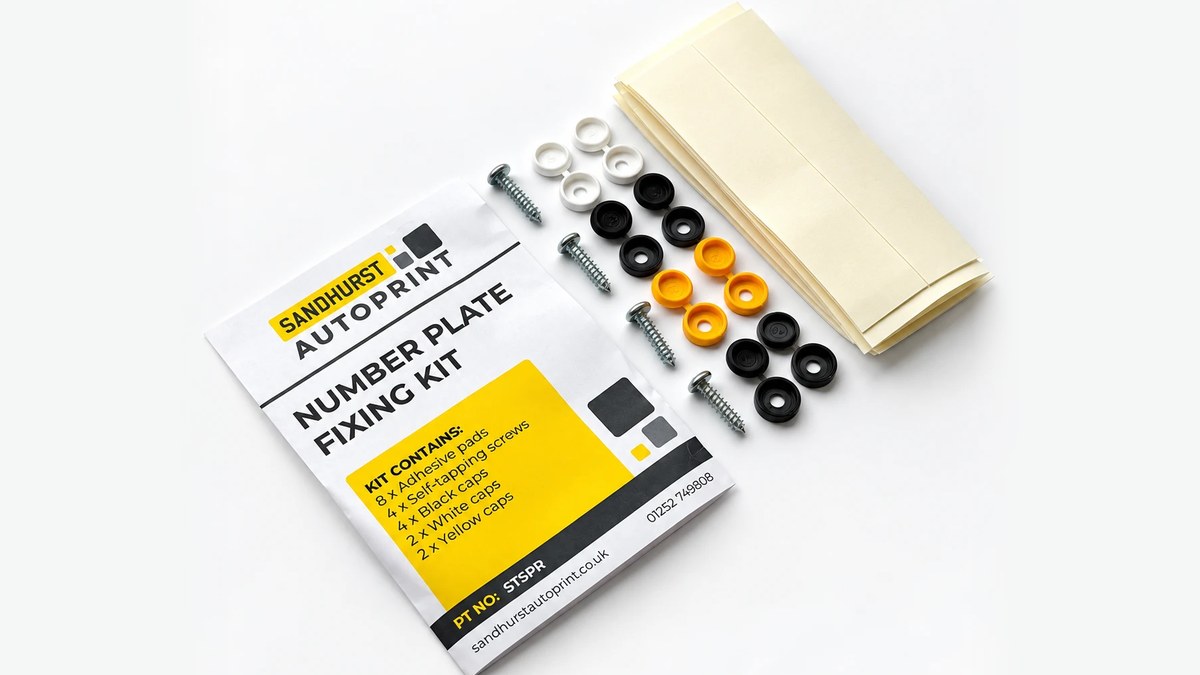
Number plate fixings: screws, sticky pads or both
Screws are still permitted, but we recommend sticky pads. What the regulations and the MOT say about fixing a number plate, which fixing suits which job, and how to fit plates that stay put.
Read article →
Getting February and August right: a pre-order planning guide
New registration periods reward the sites that plan stock in advance. How to forecast volume, when to place a pre-order, and what to hold versus what to order in.
Read article →