
Number plate fixings: screws, sticky pads or both
Every plate you supply has to be fixed to a vehicle, and the fixing decides whether it stays put, stays readable and passes its next MOT. Number plate fixings are a small part of the job, but when they fail the comeback lands on whoever fitted the plate.
This guide is for garages, dealers, plate makers and motor factors. It covers what the law and the MOT say about fixing a plate, when to use screws, sticky pads, anti-theft fixings or frames, and how to fit a plate so it does not come back.
Our position, so you know where the guide leans: screws are still permitted, and we stock them, but Sandhurst Autoprint recommends sticky pads. A pad holds the plate without piercing it and puts nothing near the characters, which is where most fixing problems start.
What the law says about fixing a number plate
The rules sit in the Road Vehicles (Display of Registration Marks) Regulations 2001. Front and rear plates must be fixed vertically, or as close to vertical as is reasonably practicable, and positioned so the characters are easy to read in normal daylight.
The regulations do not ban any particular fixing. They ban the effect. A plate must not be fixed by a screw, bolt or other fixing device of any type or colour, in any position, or in any other manner, that:
- changes the appearance or legibility of any character
- makes the characters less easy to read
- prevents or impairs a true photographic image of the plate by a camera or other device
That last point is about automatic number plate recognition (ANPR). A fixing that looks harmless to the eye can still change what a camera reads.
BS AU 145e, the British Standard for the plate itself, does not set fitting requirements. BSI states that fixing is prescribed by the 2001 Regulations, so that is where the rules on screws and pads come from. The BS AU 145e supplier guide covers what the standard does require.
What the MOT tester checks
Number plates are the first item in the MOT inspection manual, and several of the checks come down to fixings.
A plate that is missing, or so insecure that it is likely to fall off, is a major defect. So is a plate that does not conform to the requirements, which include having no feature or fixing that changes the appearance or legibility of any character.
The manual tells testers to pay particular attention to the position of fixing screws and bolts, and to any delamination. The reason it gives is that ANPR cameras see any non-reflective material as black. A dark screw head next to a character can read as part of it.
Screws: still permitted, with care
Nothing in the regulations bans screws, and they remain a legitimate fixing. The reason we do not recommend them as the default is that every screw pierces the plate, and every hole is a weak point in the acrylic that can lead to cracking and delamination over time. Where you do use them, they give a mechanical fixing that does not depend on a clean, flat, dry mounting surface. They are the usual choice where:
- the vehicle already has screw holes or a threaded mounting
- the mounting surface is textured or uneven
- the plate will need to come off and go back on, for example during bodywork
Drill only in the margin, never through or beside a character, and do not overtighten. If the plate can take pads instead, use pads.
Choosing the screw
- Poly top screws have a coloured plastic head, so the head itself can match the plate background.
- Self-tapping screws cut their own thread into the mounting and take a matching cap.
- Plastic bolts and nuts suit mountings with through holes, where a nut can be fitted behind.
Whichever you use, match the head or cap to the plate background: white on the front, yellow on the rear. That keeps the head from reading as part of a character.
Sticky pads: the fixing we recommend
Adhesive pads hold the plate without piercing it, so the face stays intact, the plate keeps its full strength and there are no screw heads near the characters for an ANPR camera or an MOT tester to object to. That is why they are our recommended fixing. They suit:
- smooth, flat mounting surfaces, such as most modern bumpers and plate plinths
- vehicles with no screw holes, where the customer does not want new ones drilled
- plates with raised characters, where drilling risks damaging the plate
Pads only work as well as the surface they are stuck to. Clean off wax, dirt and old adhesive, make sure the surface is dry, and check the pad maker's guidance on application temperature before fitting outdoors in cold weather.
Use enough pads to support the whole plate, near each end and along the middle, so it cannot flex or rattle. Once the plate is in position, press firmly over each pad.
Anti-theft screws and locking frames
A plate that comes off easily can end up on another car. gov.uk points motorists to theft-resistant number plates, which make it harder for someone to remove a plate quickly and reuse it.
On the fixing side, anti-theft screws are designed to resist a standard screwdriver, and a locking backing frame holds the plate in a frame that needs a key to release it.
Both are an easy add-on for customers who have had a plate stolen or who park on the street. The guide to a lost or stolen number plate covers what the motorist needs to do next.
Backing frames and lipped plates
A backing frame sits between the plate and the vehicle. It gives the plate a flat, rigid base on an uneven mounting, and tidies up a plate that would otherwise sit loose against the bodywork.
Whatever frame you fit, it must not cover any character or make the registration harder to read. The MOT manual treats a plate obviously obscured by objects or attachments as illegible, which is a major defect.
Lipped plates have a raised edge and need a frame made for them. For vehicles first registered on or after 1 September 2021, the MOT manual allows an integral raised or depressed border no more than 5mm wide and 2mm high.
Which fixing for which job
| Job | Fixing | Why |
|---|---|---|
| New plate on a smooth bumper with no holes | Adhesive pads (our recommended default) | No drilling, no weak points in the plate and no screw heads near the characters |
| Replacement plate with existing screw holes | Poly top or self-tapping screws with matching caps | Uses the holes already there |
| Textured or uneven mounting | Backing frame, then screws or pads | Gives the plate a flat, rigid base |
| Customer worried about theft | Anti-theft screws or a locking frame | Slower and harder to remove |
| Plate that keeps working loose | Pads and screws together | Two independent fixings |
Fitting that prevents comebacks
- Check the new plate before it goes on: the right registration, the supplier mark and the BS AU 145e mark.
- Remove the old plate and all old adhesive, then clean and dry the mounting surface.
- Offer the plate up and check it sits vertically, with nothing covering any part of the registration.
- If you are screwing, drill only in the margin, well away from every character.
- Fit a matching cap or poly top on every screw.
- Press each pad firmly, then check the plate cannot flex at the ends.
- Step back and read the plate from a distance in daylight.
- Dispose of the old plates securely. The DVLA advises cutting them into at least four pieces, with no piece showing more than half the registration number.
Number plate fixings with Sandhurst Autoprint
Sandhurst Autoprint supplies number plate fixings to the motor trade: poly top screws, anti-theft screws, self-tapping screws and caps, plastic bolts and nuts, plain, lipped and locking backing frames, and adhesive foam and VHB pads. Screws are still permitted and we stock the full range, but our recommendation is secure sticky pads, because a screw that pierces the plate can compromise its durability.
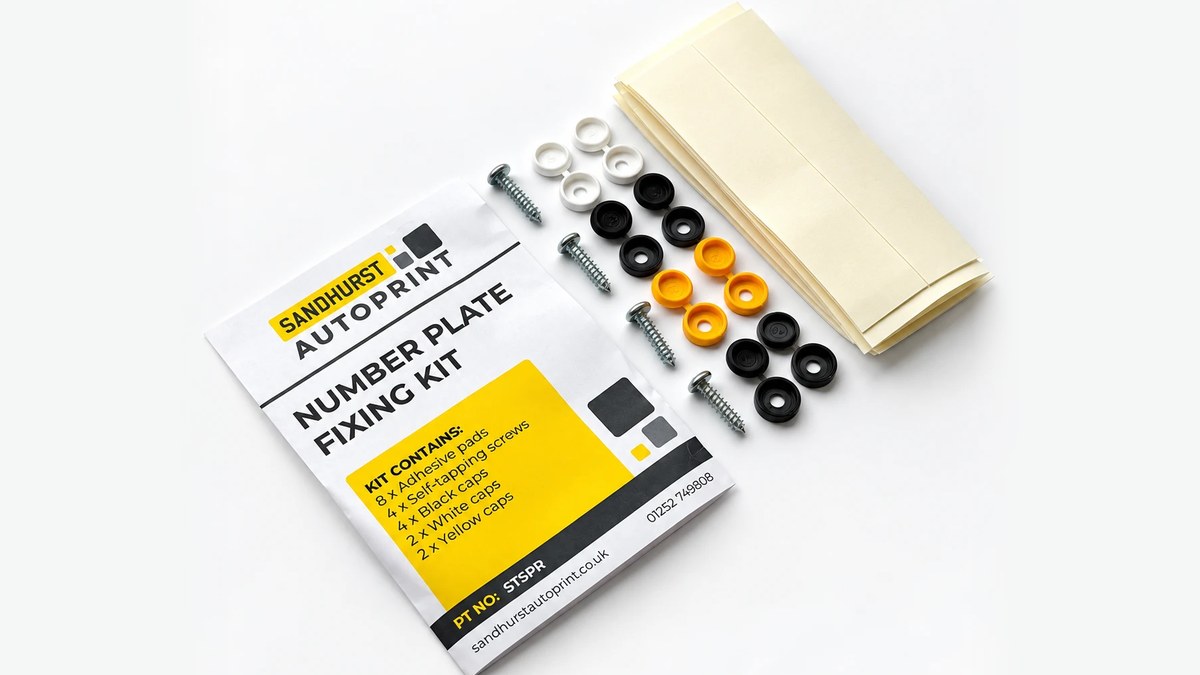
For counter sales, our number plate fixing kit (part number STSPR) covers either route in one packet: eight adhesive pads, four self-tapping screws, and black, white and yellow caps to match the plate.
Fixings can go on the same order as your number plate components or ready made plates, which saves a separate supplier and invoice. Selling over a counter? See how motor factors build fixings into the plate sale. To add fixings to your account, talk to your Support Manager, or open a trade account.
Frequently asked questions
Is it legal to screw a number plate on?
Yes. The law does not ban screws. It bans any screw, bolt or other fixing, of any type or colour and in any position, that changes the appearance or legibility of the characters or impairs a camera image of the plate.
Are sticky pads or screws better for number plates?
Both are permitted. Sandhurst Autoprint recommends sticky pads: they hold the plate without piercing it, so there is no weak point in the acrylic and no screw head near a character for a camera or an MOT tester to pick up. Screws remain the right choice where a mechanical fixing is needed, such as existing screw holes or an uneven surface.
Can a number plate fail an MOT because of its fixings?
Yes. A plate so insecure that it is likely to fall off is a major defect. So is a plate with a fixing that changes the appearance or legibility of any character.
What colour number plate screw caps should I use?
Match the cap to the plate background: white on the front plate and yellow on the rear. ANPR cameras see non-reflective material as black, so a dark screw head beside a character can make it misread.
Does BS AU 145e cover how a number plate is fitted?
No. BSI states that BS AU 145e does not set requirements for fitting. Fixing is covered by the Road Vehicles (Display of Registration Marks) Regulations 2001.
Do anti-theft screws stop number plate theft?
They make a plate slower to remove, which deters a quick theft. gov.uk also points motorists to theft-resistant number plates, which make it harder for someone to remove a plate quickly and reuse it.

Getting February and August right: a pre-order planning guide
New registration periods reward the sites that plan stock in advance. How to forecast volume, when to place a pre-order, and what to hold versus what to order in.
Read article →
Make or buy: when in-house production beats ready made plates
Equipment cost, labour, wastage and capital tied up in stock. An honest look at the point where producing your own plates pays, and the point where it does not.
Read article →