
Getting February and August right: a pre-order planning guide

Twice a year the UK number plate market goes from steady to flat out. New registration identifiers arrive on 1 March and 1 September, and dealers register a large share of the year's new cars in those two months.
The suppliers who cope best are the ones who did their planning in February and August. This guide covers how to forecast the peak, when to place a pre-order, and what stock to hold versus what to order in.
Why March and September matter
Buyers like a new plate, so they time their purchases around the change. The effect on volume is huge.
In March 2026, 380,627 new cars were registered in the UK. That was the strongest March since 2019. August, by contrast, accounts for only around 4% of the year's registrations, because buyers hold off for September.
For a number plate supplier, that means a quiet month followed straight away by the busiest weeks of the half year. If your stock is sized for a normal month, you will run short at the worst possible moment.
The next two plate changes
| Plate change | Identifier | Pre-order month |
|---|---|---|
| 1 March 2027 | 27 | February 2027 |
| 1 September 2027 | 77 | August 2027 |
March plates carry the last two digits of the year. September plates add 50 to that number.
Step 1: forecast your volume
A good forecast does not need to be complicated. It needs to be done early, and it needs to use your own numbers.
Start with last year. Pull your plate sales for the same plate change month last year, broken down by week. The first two weeks of the month usually carry the heaviest load.
Talk to your dealers. Franchise dealers and dealer groups know their registration targets well before the change. Ask each key account what they expect to register, and whether any pre-registrations are planned for the last days of the month.
Adjust for changes in your business. Add new accounts, remove lost ones, and allow for any new site or branch opening.
Check the wider market. The SMMT publishes monthly registration figures and a market outlook. If the market is up on last year, your forecast should reflect that.
Add a buffer. A shortfall costs you more than a small surplus. Most of what you hold for the plate change is standard stock that will sell in the following months anyway.
Step 2: pre-order early
The best time to place a pre-order is before everyone else does. Supply chains feel the plate change too. Manufacturers and distributors see demand climb at the same time across the whole country.
- January and July: finish your forecast.
- February and August: place your pre-order and agree delivery dates.
- Last two weeks before the change: top up any lines that are running faster than forecast.
- First fortnight of March and September: track sales daily and reorder quickly.
A pre-order also helps your cash flow planning. You know what is arriving and when, so you can plan the payment rather than scrambling for stock at short notice.
Step 3: decide what to hold and what to order in
Not every line deserves shelf space. Split your range into what you need on the shelf on day one and what you can order when a job comes in.
Hold in stock for the plate change
- Standard oblong blanks, 520 x 111mm, front and rear
- Characters or printing media for your standard format
- The flags and identifiers your customers ask for most, usually UK and the Union flag
- Fixings, pads and screws
- Printer consumables, if you print your own plates
Order in as needed
- Oversize oblongs and squares
- Motorcycle and import sizes
- Shaped plates for specific models
- Less common flags and identifiers
- Show plates and specialist orders
Standard lines move quickly and predictably in the plate change weeks. Specialist lines sell slowly, tie up cash and are easy to reorder.
Step 4: get the counter ready
Stock is only half of the plan. The plate change also puts pressure on your paperwork and your people.
- Check your RNPS records. Every plate still needs proof of identity and proof of entitlement, however busy the counter gets. Our guide to RNPS record keeping sets out what to record.
- Brief your team. Make sure anyone covering the counter knows which documents to accept and which requests to refuse.
- Check compliance. Rushed plates are where mistakes creep in. Every plate still has to meet BS AU 145e.
- Service your equipment. A printer or press that breaks down in the first week of March costs far more than a service in February.
Common planning mistakes
- Forecasting from memory. Use last year's sales data, not a feel for how busy it was.
- Ordering at the last minute. Late orders compete with every other supplier in the country.
- Holding too much specialist stock. Shaped and oversize plates rarely sell in volume at the plate change.
- Forgetting consumables. Running out of ink, film or fixings stops production as surely as running out of blanks.
- Not reviewing afterwards. Compare your forecast with actual sales once the peak is over. That comparison makes next year's forecast better.
Plan the plate change with Sandhurst Autoprint
Sandhurst Autoprint is a registration plate supplier to the motor trade. We supply BS AU 145e compliant number plate components and ready made plates to plate makers, dealer groups, garages and fleet operators.
Talk to your account manager about your plate change forecast and pre-order. Trade customers can also order through the Sandhurst Autoprint Trade Portal, which holds your negotiated pricing, orders by branch and keeps your artwork on file.
Plate change planning checklist
- Last year's sales for the same month pulled by week
- Registration plans confirmed with key dealer accounts
- Forecast adjusted for new and lost accounts
- Buffer added for standard lines
- Pre-order placed in February or August
- Delivery dates agreed
- Specialist lines set to order as needed
- Consumables and fixings checked
- Equipment serviced
- Counter team briefed on RNPS documents
- Forecast compared with actual sales after the peak
Frequently asked questions
When do new registration plates come out?
Twice a year, on 1 March and 1 September. March plates use the last two digits of the year, so March 2027 plates carry 27. September plates add 50, so September 2027 plates carry 77.
When should I place a pre-order for the plate change?
Place it in February for March and in August for September, and earlier if you can. Your forecast should be done in January and July, so the order goes in before supply tightens.
How do I forecast plate change volume?
Start with what you sold in the same month last year, then adjust for your dealers' registration plans, any new or lost accounts, and what the wider market is doing.
What number plate stock should I hold?
Hold enough standard oblong blanks, characters and fixings to cover your forecast for the fortnight around the plate change. Order specialist sizes, shaped plates and less common flags as you need them.
Why is August so quiet for new car registrations?
Buyers wait for the September plate change, so August accounts for only around 4% of the year's new car registrations.
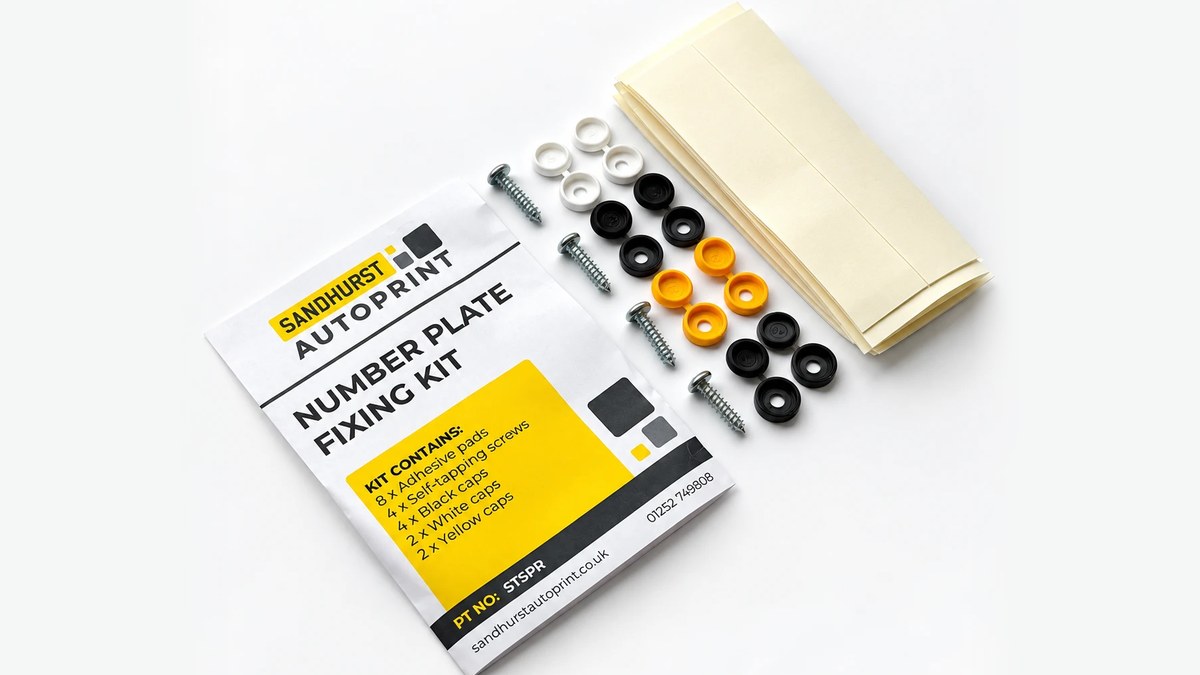
Number plate fixings: screws, sticky pads or both
Screws are still permitted, but we recommend sticky pads. What the regulations and the MOT say about fixing a number plate, which fixing suits which job, and how to fit plates that stay put.
Read article →
Make or buy: when in-house production beats ready made plates
Equipment cost, labour, wastage and capital tied up in stock. An honest look at the point where producing your own plates pays, and the point where it does not.
Read article →