BS AU 145e: what a supplier is actually required to do
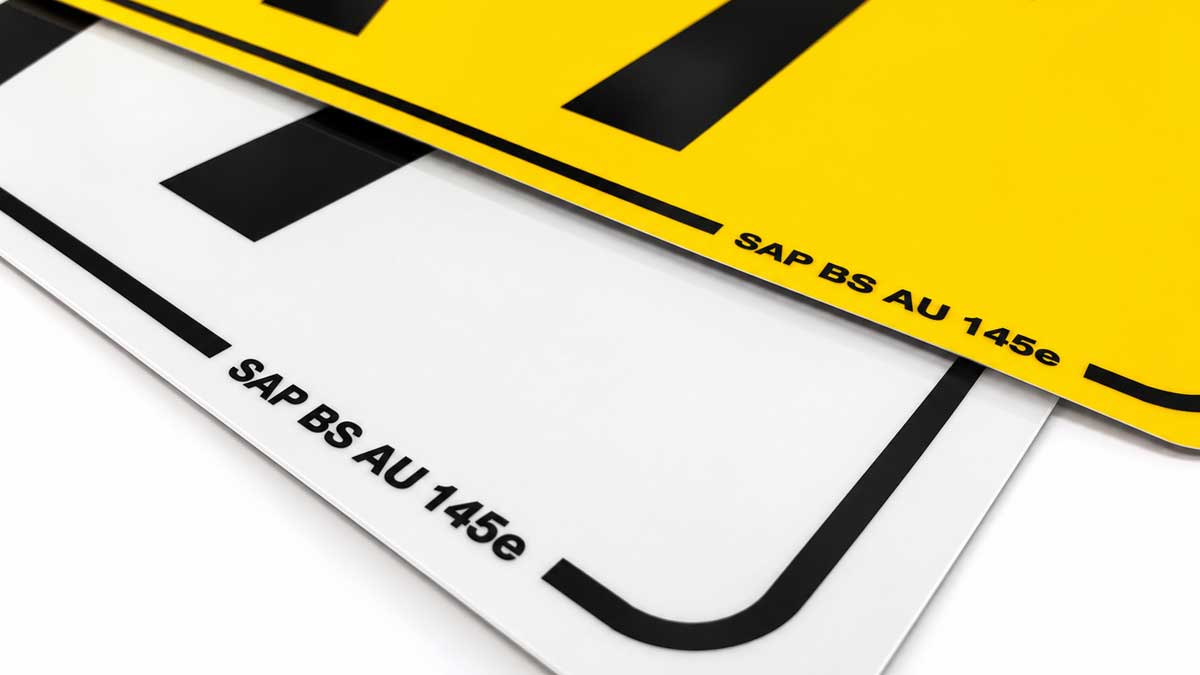
The British Standard for number plates changed on 1 September 2021. Every plate fitted since then must meet BS AU 145e. Most of the responsibility for that sits with the number plate supplier, not the motorist.
If you make or sell registration plates, you are the one who has to get this right. This guide covers what the standard requires, what changed from the old version, and what it means for the components you buy.
What BS AU 145e is
BS AU 145e is the British Standard for retroreflective number plates. It sets how a plate must look and how it must perform. It covers reflectivity, strength and how well a plate stands up to weather and wear.
It replaced BS AU 145d. Plates fitted before 1 September 2021 can stay on the vehicle, provided they met 145d when they were made. Any new or replacement plate must meet 145e.
What changed in 2021
The biggest visible change covers the characters themselves. Under 145e, the registration number must be printed in a single shade of black. You cannot use two tones of black, shading or highlighting to create a 3D effect.
DVLA guidance also makes clear that the whole character must be black. That includes the sides of raised characters, so clear or coloured sides are not allowed. Characters also cannot be removable, reflective or lit up.
The second change is less visible but matters just as much. 145e raised the performance requirements, so plates must be more durable and stay readable for longer. That makes your choice of number plate components a compliance issue as well as a quality one.
Are 3D and 4D number plates legal?
Yes, if they are made correctly. Raised characters are allowed under BS AU 145e as long as:
- every surface of each character, including the sides, is the same single shade of black
- the characters are fixed and cannot be removed
- the font, size and spacing match the standard
- the plate is marked as meeting BS AU 145e
A raised plate with two-tone effects or clear edges does not comply, whatever the product listing calls it. If the vehicle fails its MOT or the owner is fined, the supplier mark on the plate shows who made it.
The layout rules every plate must follow
The standard font and dimensions have not changed since September 2001. They still apply to every plate you produce.
| Element | Requirement |
|---|---|
| Character height | 79mm |
| Character width | 50mm (except the number 1 and the letter I) |
| Stroke thickness | 14mm |
| Space between characters | 11mm |
| Space between groups | 33mm |
| Top, bottom and side margins | 11mm |
| Vertical gap between lines | 19mm |
| Background | White at the front, yellow at the rear |
| Font | The standard font only. No italics or decorative styles |
| Background pattern | Not allowed |
Motorists often ask for tighter spacing or a stylised font to change how a registration reads. That is exactly what makes a plate illegal. A clear refusal policy at the counter protects both you and the customer.
Number plate sizes and shapes
The standard oblong plate is 520mm x 111mm. Plenty of vehicles need something else. Motorcycles, imports and some prestige models have recesses that a standard plate will not fit.
The plate size and shape can change to suit the vehicle, but the character rules above still apply. In practice, a supplier needs a range of blanks in stock to cover:
- Standard oblongs, 520 x 111mm
- Oversize oblongs, from 508 x 152mm up to 565 x 184mm
- Squares, including standard, oversize and Euro
- Motorcycle plates, 235 x 178mm
- Import plates, including American and small and large Japanese sizes
- Shaped plates, for models such as the Aston Martin DB9, Jaguar XJ, Range Rover Sport and Rolls Royce Phantom
Where a vehicle cannot take a standard plate, DVLA guidance in INF104 sets out the limited allowances. Check this before you produce a non-standard plate.
Flags, identifiers and the green flash
A plate may show a national flag and identifier on the left-hand side. The permitted flags are:
- the Union flag
- the Cross of St George
- the Saltire
- the Red Dragon of Wales
These can sit with identifiers such as UK, GB, ENG, ENGLAND, SCO, SCOTLAND, CYM, CYMRU or WALES. Since 28 September 2021, UK has replaced GB as the recognised code for driving abroad. So a customer who takes the car to Europe should choose the UK identifier.
Zero-emission vehicles have been allowed a green flash on the left of the plate since December 2020. Any other logo, badge or symbol is not permitted.
The marks a supplier must put on every plate
This part of the standard applies directly to you. Every plate must show:
- the British Standard number, BS AU 145e
- the name or trademark of the manufacturer or supplier
- the name and postcode of the outlet that supplied it
The supplier mark is how the DVLA and the police trace a plate back to where it was made. If that plate turns out to be non-compliant, or was made without the right checks, the trail leads to your business.
That ties BS AU 145e to your obligations as a registered number plate supplier. You must be registered with the DVLA's Register of Number Plate Suppliers (RNPS). You must also check the customer's identity and their right to the registration before you make the plate. We cover what records you need to keep, and for how long, in our guide to RNPS record keeping.
Why your components matter
The standard does not only apply to the finished plate. DVLA guidance says that suppliers who make components in-house are responsible, by law, for making sure those components can comply.
In practice, the plate you hand over is only as compliant as the materials it is built from. The key number plate components are:
- Reflective sheeting and plate blanks. These carry most of the reflectivity and durability performance under 145e.
- Characters and printing media. These must give a single shade of black that lasts, with no fade, bleed or two-tone finish.
- Raised character sets. These must be solid black on every face, including the sides.
- Flags, identifiers and fixings. These keep the plate legal, secure and readable over its working life.
If a supplier buys cheap or untested components, it takes on compliance risk it cannot see. The problem only shows up later, as a failed MOT or a complaint from a customer.
How Sandhurst Autoprint supports compliance
Sandhurst Autoprint is a registration plate supplier to the motor trade. We supply BS AU 145e compliant number plate components and ready made plates. Our trade customers include plate makers, dealer groups, independent garages and fleet operators.
Trade customers can order through the Sandhurst Autoprint Trade Portal. The portal holds your negotiated pricing, orders by branch and keeps your artwork on file.
BS AU 145e checklist for suppliers
- Plate marked with BS AU 145e
- Supplier name or trademark shown
- Supplying outlet's name and postcode shown
- Single shade of black on every character surface, including raised sides
- Standard font, sizes and spacing, whatever the plate size or shape
- Only permitted flags, identifiers or green flash
- No background pattern, removable characters or reflective characters
- Customer's ID and entitlement checked and recorded under RNPS rules
Frequently asked questions
When did BS AU 145e come into force?
It came into force on 1 September 2021. All new and replacement plates fitted from that date must meet it.
Do I need to replace plates made under BS AU 145d?
No. Plates fitted before 1 September 2021 that met BS AU 145d can stay on the vehicle.
Are 4D number plates legal in the UK?
Raised characters are legal if every surface, including the sides, is a single shade of black, the characters are fixed, and the plate meets BS AU 145e.
What size is a standard UK number plate?
The standard oblong plate is 520mm x 111mm. Oversize, square, motorcycle, import and shaped plates are available for vehicles that need them.
Can I still use a GB identifier?
GB with the Union flag is still an authorised identifier. For driving abroad, UK has been the recognised code since 28 September 2021.
What must a number plate supplier print on each plate?
The BS AU 145e mark, the manufacturer or supplier's name or trademark, and the name and postcode of the supplying outlet.
What is the penalty for an illegal number plate?
The driver can be fined up to £1,000, the vehicle can fail its MOT, and the DVLA can withdraw the registration number.
Cloned number plates: the DVLA's new online reporting service
The DVLA and police in England and Wales have launched a single online form for reporting cloned number plates. What it does, what it does not do, and what the crackdown means for plate suppliers.
Read article →
Ghost number plates: what the crackdown means for plate suppliers
A national crackdown on ghost number plates has put plate suppliers in the spotlight. What the law already says, what is still under review, and how to protect your counter and your records.
Read article →